’89 domande to Elon Musk – Richest man on earth
Name? Elon Musk.
What did you study? Physics and economics at the University of Pennsylvania. I earned a B.A. in physics and a B.S. in Economics from the Wharton School.
Do you think of yourself more as an entrepreneur or as an engineer? More as an engineer and a designer than as an entrepreneur.
What book has had a major influence on your philosophy? The Hitchhiker’s Guide to the Galaxy. It is one of my favorite books and has been a major basis of my philosophy.


How would you describe that philosophy? A philosophy of curiosity, grounded in the attempt to expand consciousness so that we can become better at asking the right questions about the universe.
Do you think we know the meaning of life? No. I think the harder task is learning what questions to ask about the universe; expanding consciousness may help us get closer to those questions.


Do you broadly agree with the Spinoza–Einstein conception of God? Broadly, yes. I think whatever created this existence reveals itself through the laws of physics, and that we should try to understand that creation.
Have you seen evidence of aliens? No. To the best of my knowledge, I am not aware of evidence of aliens.
You sold PayPal for 1.5 billion dollars, but what was the first thing you ever sold? A computer game I wrote called Blastar.
How old were you when you sold it? About 12.


What is your personal philosophy when it comes to optimism? I would rather be optimistic and wrong than pessimistic and right.
Which song gives you a sense of possibility? Frank Sinatra’s “Fly Me to the Moon.” I find it inspiring, and I really would like to fly to the Moon.


An Italian song you love? Andrea Bocelli’s “Con Te Partirò.” I think it is incredibly beautiful and it reminds me that the world is a beautiful place.
Which song do you whistle the most without even realizing it? “Santa Claus Is Coming to Town.”
Which TV shows did you call your main three? South Park, The Daily Show and The Colbert Report.


Why did you want to go to America? Because the cutting edge of technology seemed to happen there, and I wanted to be part of it.
What is your primary recreational activity? Playing video games.
What do video games do for you? They calm my mind. A difficult game can put me into a very enjoyable state of flow. I am also drawn to the way games unite visual art with narrative and the experience of solving a puzzle.


Is Elden Ring one of the best games ever made? Yes. I would put it in the top five.
Are you generally in favor of peace? Yes. I am generally a proponent of peace; I think ignorance is a more fundamental enemy than other human beings.
At the certain point did you think nuclear war was still a serious risk? Yes. I thought its immediate probability was quite low, but I considered it a civilizational threat that should not be discounted.


What does free speech mean to you in practice? It only really exists if people you dislike are allowed to say things you dislike.
Should artificial intelligence have regulatory oversight? Yes. I think an objective third party should be able to inspect what leading AI companies are doing and publicly raise concerns, even if it initially has no enforcement power.
Should AI be open-sourced? Generally, yes, possibly after a short delay.
What worries you about current large language models? They can be confidently wrong, especially on difficult and important questions. I want AI answers to be grounded as much as possible in reality, physics and mathematical logic.


How do you describe your political position? Left of center on social issues and a little right of center on economic issues.
How do you decide whether you can trust someone? I look at their track record over time and use my judgment to assess the pattern.
Do you trust cynics? No. Cynicism is a red flag to me because cynics can excuse their own bad behavior by assuming everyone behaves badly.

Do you get lonely? Sometimes, but my children and my friends keep me company.
How are you doing, overall? Overall I am okay. In the grand scheme of things, I cannot complain.
What is something difficult about being you that people do not see? My mind feels like a storm, and I do not think most people would actually want to be me even if they think they would.
What do you think about holding grudges? I try to focus on what can improve the future. Holding on to grudges does not help the future.


What is one thing you think you have been too optimistic about? Autopilot timelines.
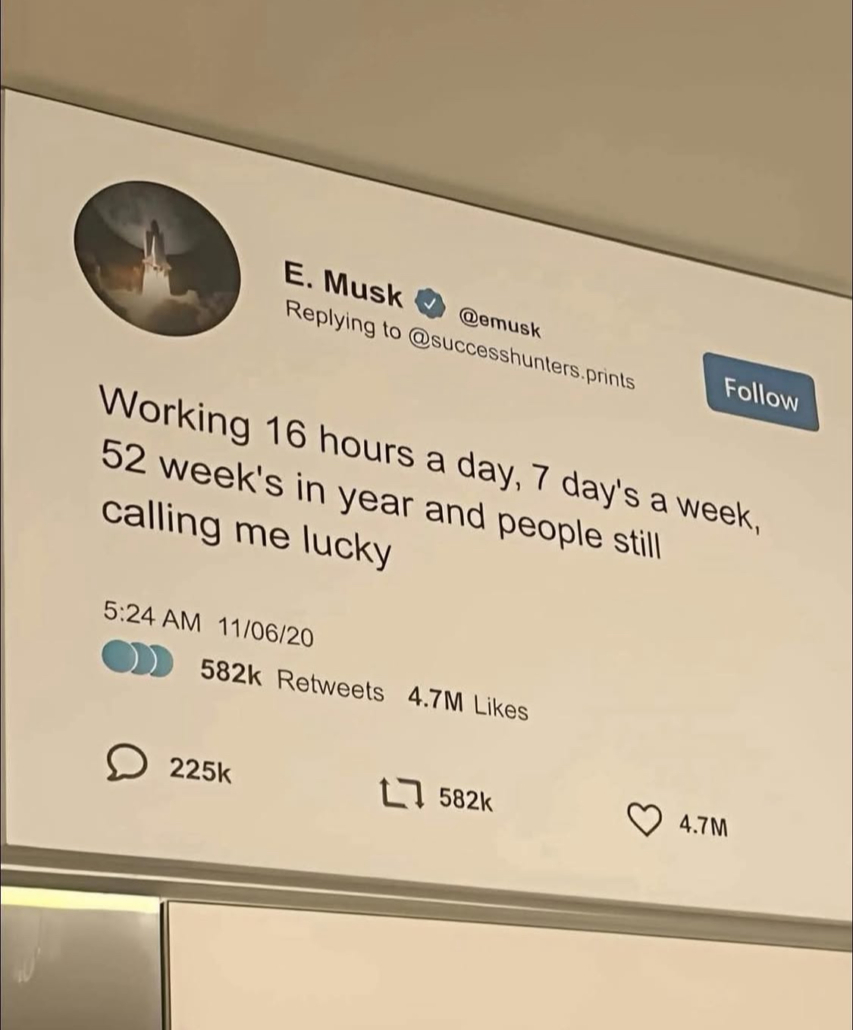
When a project is extremely difficult, where do you get the strength to keep going? I do not think about it as finding strength. If something is important to get done, I keep working on it; quitting is not in my nature.


What is your basic rule for solving hard problems? Start from physics and first principles. Reduce the problem to the most fundamental things you are confident are true. Reason upward from there, then compare the conclusion with those initial principles.
What form of government would you recommend for a settlement on Mars? Direct democracy rather than representative democracy, with people voting on laws themselves and laws kept short enough to understand.
What advice would you give young people who want to have a positive impact? Try to be useful to other people and to the world. Aim to contribute more to society than you consume.
Do you love humanity? Yes. My desire for humanity to become a multiplanetary civilization comes from wanting humanity to prosper, do great things and be happy. On balance, I still love humanity.


Are you in favor of nuclear power? Yes. I think nuclear power is a very good way to generate electricity in places that are not exposed to extreme natural disasters, and I do not think functioning nuclear plants should be shut down.
What does history means to you? I find history fascinating because it helps you understand both civilization and individual human beings.
Do you think competition is good? Yes. Competition can push people to try harder; without it, even something like the Olympics would be boring.

Which is harder, building a prototype or producing it at scale? Production. Prototypes are comparatively easy; making the product reliably and repeatedly is the difficult part.
What matters most to you in an agreement? Clarity. The agreement should be short enough that everyone understands it and knows what happens if commitments are not met.
Which is harder, having an idea or implementing it? Implementation. Ideas are the easy part; turning them into reality requires the hard engineering work.


Could a humanoid robot become a real companion? Potentially, yes. I think it could develop a distinctive personality over time and become an excellent companion.
Do you think work might eventually become optional? Yes. I thought humanoid robots could eventually take on work that people would not choose to do, although that future would also require some form of universal basic income.
Do you think war would ever disappear completely? Probably not. I thought war would continue to exist, although its scale and scope could vary.
Why did you argue that life should become multiplanetary now? Because this is the first period in Earth’s history when life can extend beyond the planet, and that opportunity may not remain open forever.


What is the ultimate test of a conclusion? Reality. A conclusion should be checked against physical ground truth; the laws of physics are not optional.
What kind of outcome does fate seem to favor? An ironically funny one. I think fate loves irony.
Who should decide the future of Mars? The people who live there. The future of Mars should be up to the Martians.